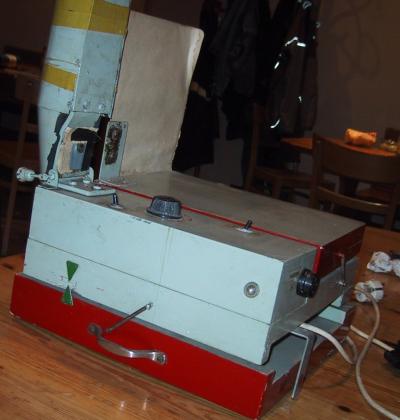
Most amateur astronomers use the Foucault shadow test to test the mirror during polishing and parabolizing. A Foucault tester can be assembled at home from just a few parts and allows the mirror to be measured with an accuracy of approximately 1/10,000-th of a millimeter.
I tested my first mirror, the 10" f/5.4, with a primitive Foucault tester made from a piece of curtain rod tubing on a small board, initially using a 6V bicycle lightbulb on millimeter paper and later with a plastic caliper. It's astonishing how high the measurement accuracy can be, even with such improvised testers (see the comparison measurements of old versus new in "My Very First Mirror" on the Astrotreff forum).
For the next mirrors, including the 17.5" f/4.5, I was able to use the Foucault tester, which can now certainly be described as historical and had been owned by Klaus Jünemann since the 1990s. It must have served several generations of Berlin mirror makers as a measuring instrument.
|
More Details... |
For a while, I used Gert G.'s Foucault slit tester. The light source (halogen lamp) is deflected by 90° using a small mirror. This brings the knife edge closer to the optical axis. The small telescope makes it easier to identify the zones and see potential surface roughness. The measurement is taken with a dial gauge with a 1/100 mm increment. With this tester, I achieved a reproducibility of approximately ±0.03 mm for the zone measurements on my 24" f/4.1 telescope.
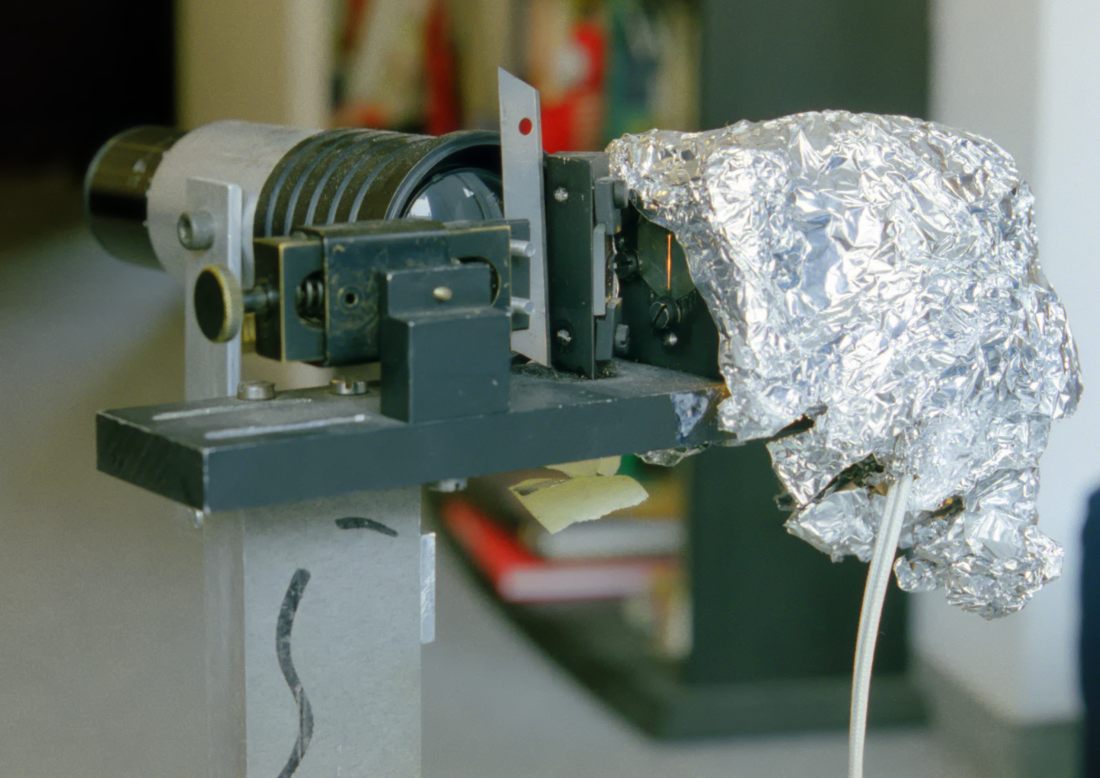
Since 2001, I've been using a slitless Foucault tester on a friend's Zeiss XY stage. Such a high precision cross slide is a nice piece of equipment, but not essential. It can also be done, for example, with an M6 threaded rod and spindle drive. An M6 thread has exactly 1 mm of pitch per turn. For information on the function of a slitless tester, see Berthold Hamburger's website.
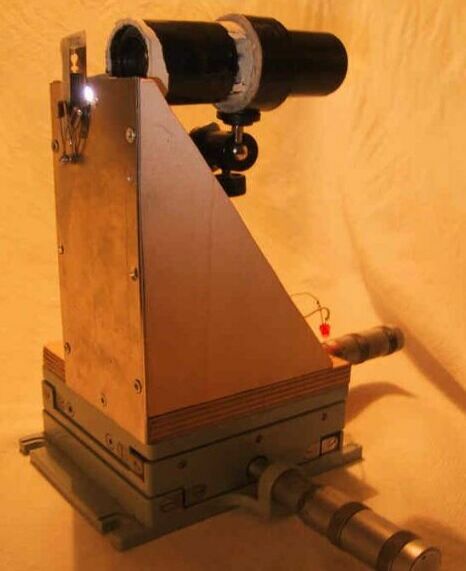 |
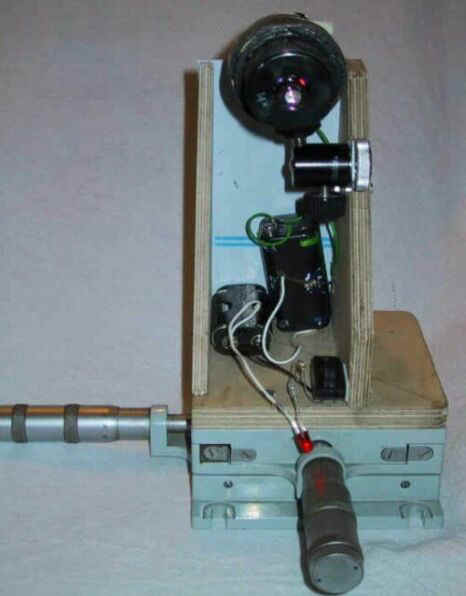
The Foucault tester at a movable light source set up. This means, the light source and the slit move together on the carriage. A small 4x telescope facilitates the identification of the zones and potential surface roughness. It is held in position with a small ball head. |
|
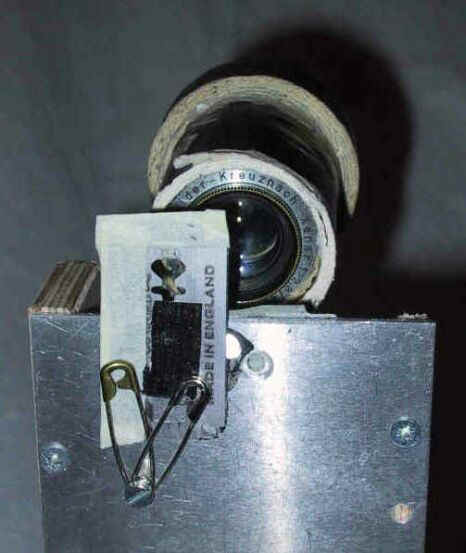
I didn't grind down the LED lens. Instead, I used thin, matte foil from a sandwich bag as a diffuser, placed directly in front of the LED. This produces a nice, bright, and evenly diffused light without reducing the brightness too much, unlike, for example, using waxed paper. The razor blade is positioned in front of the light source so that it partially covers it. Springs made from safety pins hold the razor blade in place. The light source is a white, super-bright LED from Conrad (5 mm, clear, with 3,000 mcd). It is powered by 4.5 V (3 AA batteries) and a series resistor that limits the current to 20 mA. |
|
The tester from the back with the 4x telescope tube, batteries, resistors, on/off switch and red scale illumination for reading in the dark.
|
Priniple of unterstanding the function of a Foucault Tester:
https://atmsite.udjat.nl/contrib/Harbour/Foucault.html
http://stellafane.org/tm/atm/test/understanding.html
Instructions for building a Foucault tester, mirror stand, Couder mask...:
https://stellafane.org/tm/atm/test/tester-main.html
More examples of Foucault Testers:
Spaltloser Tester von Martin Brückner
Spaltloser Tester von Gunnar Overbeck
Diverse Foucaulttester von Achim Strnad
atmsite.udjat.nl/contrib/Harbour/Tester.html
Spaltloser Foucaulttester von Petra Saliger und Gernot Stenz
Foucault analisis software:
FigureXP from James Lerch.
FoucaultXL (direct download link) from Horia Costache. Program for photographic zone analysis. Instructions can be found here.